One of my favourite paintings features Venus kissing Cupid. Cupid is her son.
A slightly awkward one to explain when someone asks what art you’re into.
It’s Bronzino’s An Allegory with Venus and Cupid. I love its beauty and its strangeness. But the explanations I kept encountering left me thinking: surely there’s more going on here?
That question turned into one of my favourite uses of ChatGPT: trying to decode a painting.
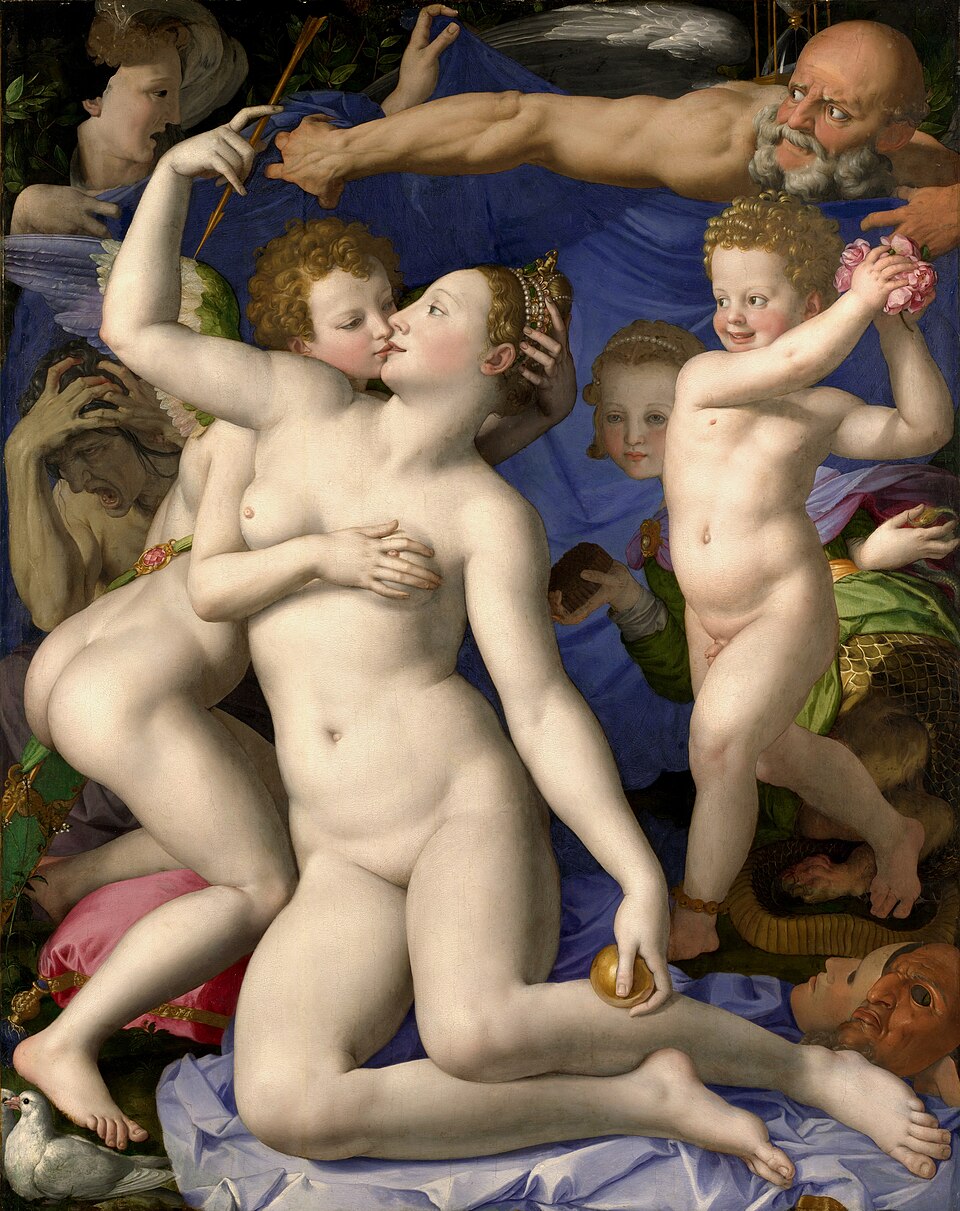
Bronzino, An Allegory with Venus and Cupid, about 1545. National Gallery, London. Public-domain reproduction via Wikimedia Commons.

An unusual gift for the King of France
The prevailing interpretation centres on lust and its consequences. The surrounding characters become clues: Pleasure, Deceit, Jealousy. The anguished figure on the left has even been interpreted as suffering from syphilis.
There is a genuine scholarly argument for that disease interpretation. It concerns the pleasures and painful consequences of sexual desire; it doesn’t claim that incest itself causes syphilis. These are overlapping interpretations, with plenty of disagreement between them.
Still, I don’t find the lust-and-punishment explanation convincing as an account of the whole painting.
Especially given who it was probably for.
The National Gallery says it was likely sent by Cosimo I de’ Medici to Francis I, King of France. That remains probable rather than certain: there is no record of it in the French royal collection. The Gallery also questions whether an overt reference to syphilis—then called the “French disease”—would have suited such a gift. National Gallery
Imagine choosing a diplomatic present for the French king and making its central message about venereal disease.
Quite an icebreaker.
That doesn’t settle the interpretation, but it makes me want to ask more questions. Who was meant to understand this? What ideas would they have recognised? What changes when we stop treating the figures’ names as settled facts?
Even the Gallery offers another possibility: Beauty restraining Passion. There was already room to keep looking. National Gallery
Following the people behind the painting
This is where having ChatGPT to talk to became really interesting.
I could follow a connection, ask about the people involved, then bring what I’d learned back to the painting. One question could become several without the whole thing turning into a research project I would inevitably abandon.
Take Bronzino’s teacher, Pontormo. Their relationship developed into decades of friendship and collaboration. The Met
Pontormo had painted a Venus and Cupid of his own, using a design by Michelangelo. And that painting belonged to a planned commission for the Florentine banker Bartolomeo Bettini, alongside portraits of Dante, Petrarch and Boccaccio by Bronzino.
Michelangelo designed the lovers. Pontormo painted them. Bronzino supplied the poets.
The room never came together as intended, but the connection between those artists, that subject and poetry is documented. Scuola Normale Superiore
That feels like a promising clue.
Bronzino also wrote poetry himself. In a later letter and sonnet to Michelangelo, he described an admiration stretching back to his youth, dedicating his hand and intellect to Michelangelo’s example. Italique
Suddenly, looking at Michelangelo’s poems seems a fairly reasonable thing to do.
A passage that seemed to fit
The poem I kept returning to was Non è sempre di colpa aspra e mortale. A plain English rendering of its opening goes:
An intense passion for immense beauty
is not always a grave and mortal fault,
if it leaves the heart so softened
that a divine arrow can soon enter it.
Later, it distinguishes two kinds of love:
One draws towards heaven, the other towards earth;
one dwells in the soul, the other in the senses.
These are literal renderings of passages from Michelangelo’s Italian.
Now that is interesting.
Here was a poem discussing beauty, desire and different forms of love, using the image of an arrow. And here was a painting of extraordinary beauty, with Venus taking an arrow from Cupid.
Could the painting be exploring that distinction? Could its central interaction concern beauty controlling or redirecting desire? Could the surrounding figures belong to a more complicated argument about love than the explanation I had started with?
The poem seemed to offer a possible way into the enigma.
With ChatGPT, I could stop at a particular line and work through it. What does the arrow mean here? What are these two kinds of love? How would someone in this circle have understood the distinction?
That ability to keep asking was the exciting part. A reference I might otherwise have skimmed past became something I could actually investigate.
The poem has its own complications. Michelangelo explicitly contrasts the higher love he describes with desire for a woman, which he dismisses. Scholarship connects that argument with his feelings for Tommaso de’ Cavalieri. His personal relationships belong in the picture too. Eisenbichler, “The Religious Poetry of Michelangelo”
There were more clues, and more questions.
Understanding the world it came from
I’m not religious myself. I find these ideas interesting because they help me imagine how the people making this art thought.
The poem also made one aspect of the Church’s patronage click for me. If you believe that beauty can move someone towards God, commissioning great art becomes a pretty significant activity. Images can teach, move people and give a physical form to something they believe in. Religious instruction and devotion were important reasons for commissioning sacred imagery. The Met
That gives me another way to understand why so much effort went into it.
And it gives me another question to bring back to Bronzino: what might beauty itself have meant to the people looking at this painting?
A promising clue, with an annoying date problem
There is one fairly important complication.
The painting is generally dated around 1545. The poem has been tentatively dated to around 1546. It might actually be later.
So I can’t claim that I’ve found the text Bronzino used to construct his painting. The artistic relationships are real; direct influence from this particular poem remains unproven. Eisenbichler
Slightly inconvenient for my detective career.
I still find the connection worth exploring. The poem gives me a way to think about the painting that feels more convincing to me, and the shared artistic world gives that curiosity somewhere to go.
ChatGPT makes following those threads unusually accessible. I can move between an image, a poem, an artist’s teacher and a disputed interpretation in the same conversation. I can ask what supports a theory, what complicates it, and where to look next.
It can also get carried away with a satisfying connection. So can I. Checking the dates is clearly useful.
What I love is being able to participate in the puzzle. I can question an explanation that doesn’t convince me, follow the people and ideas behind it, and develop a reading of my own.
When I first tried to describe how that felt, I wrote:
“It feels like I’ve been let into a secret that only I know.”
That was the thrill: the possibility that something cryptic was beginning to make sense.
A centuries-old painting, a poem in a language I needed help with, and a tool that let me keep joining the dots.
That is a very good use of an evening.